Lucy & Gracie.
Both spayed, both indoor-only, both born late September 2024. This is where I keep what's going on with each of them, what's been tried, and what's coming up.
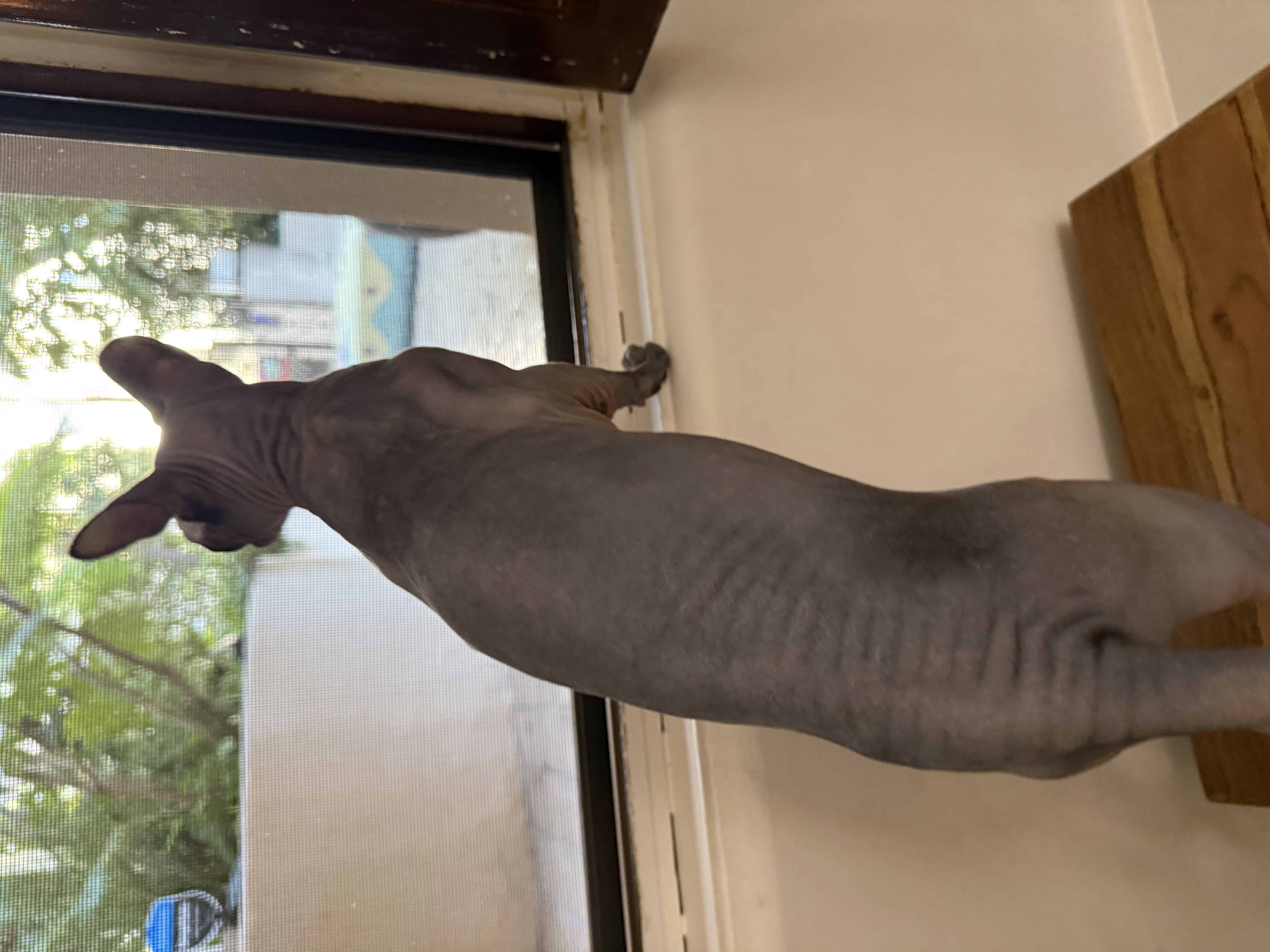
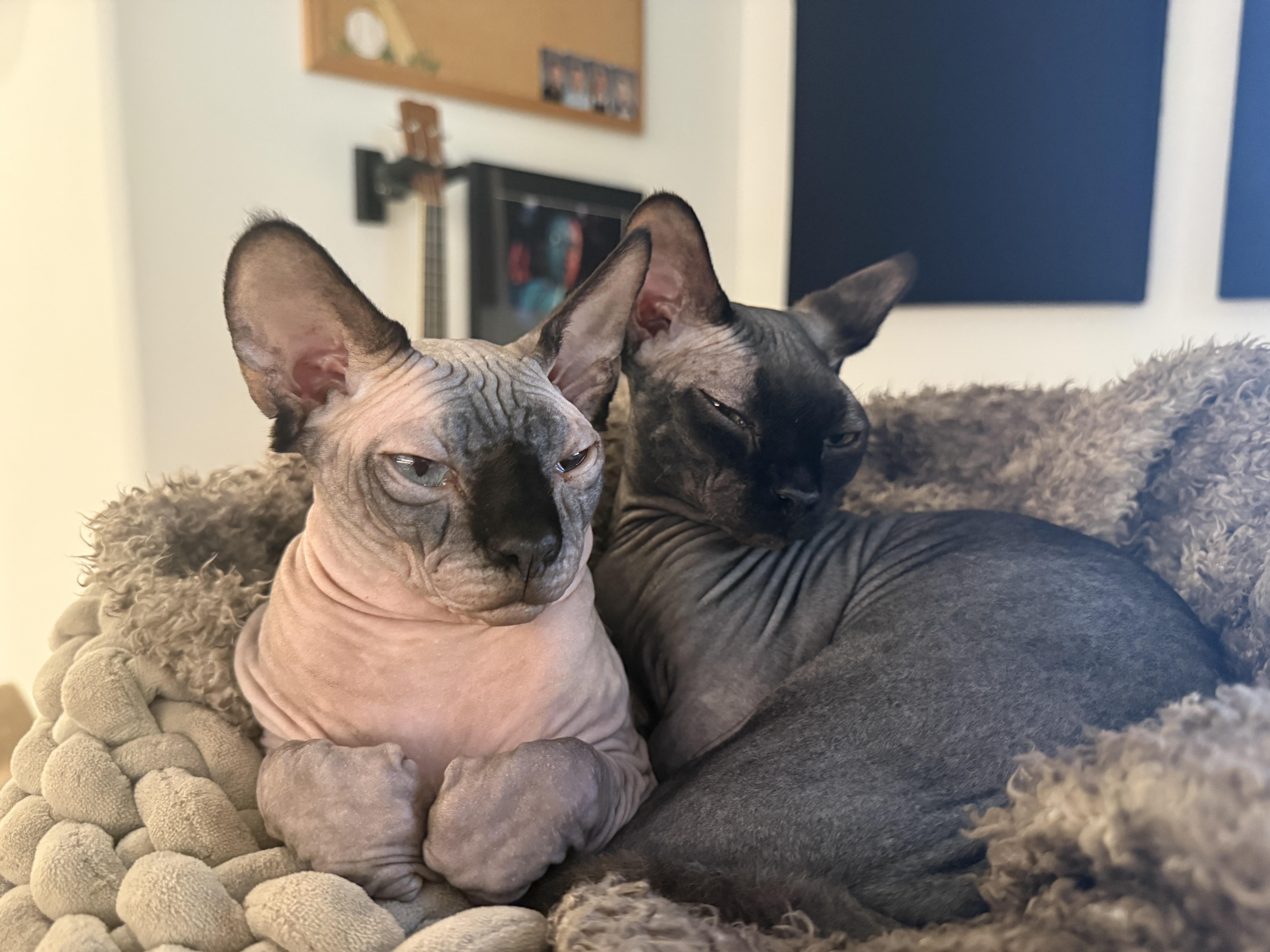
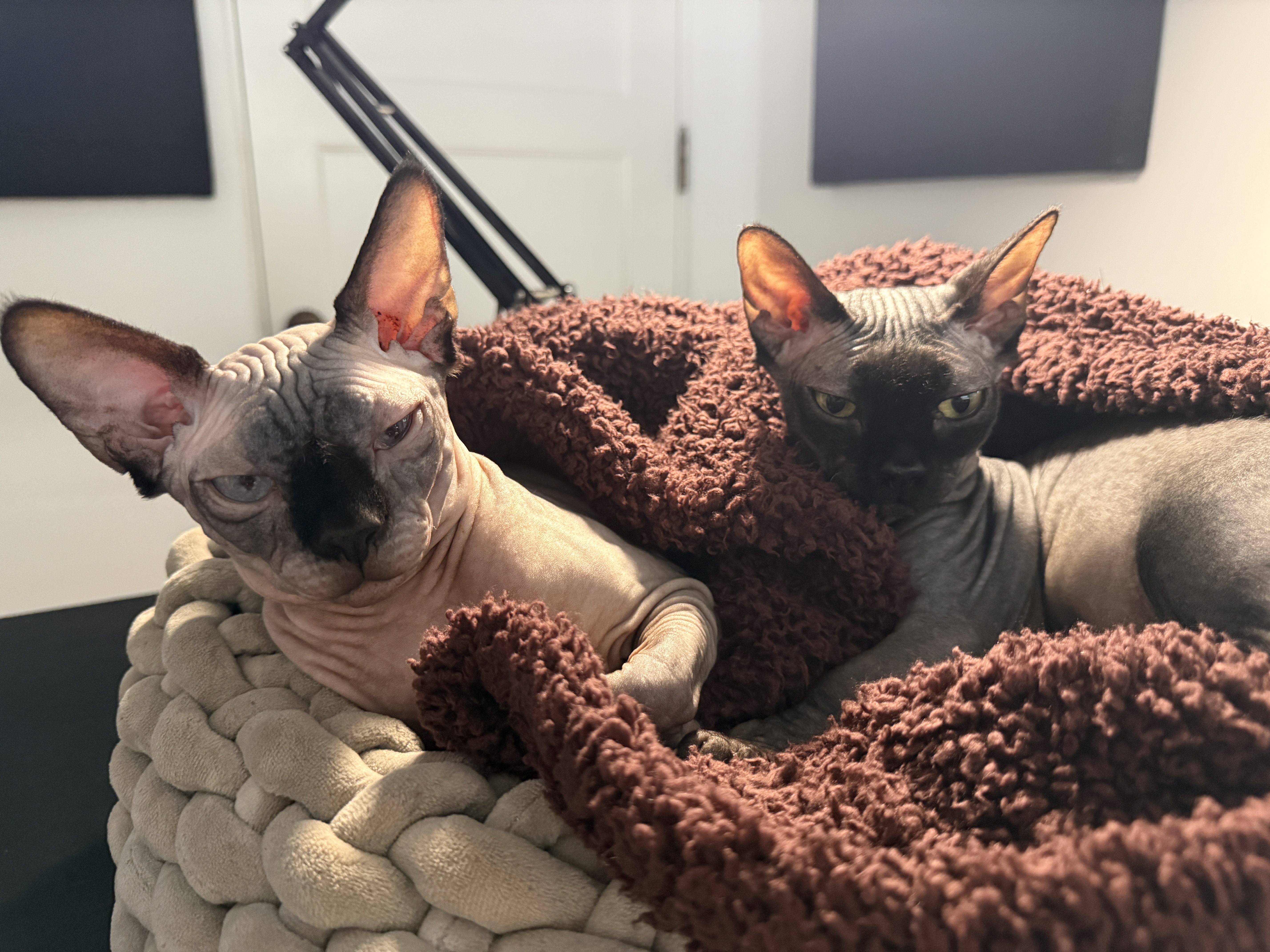
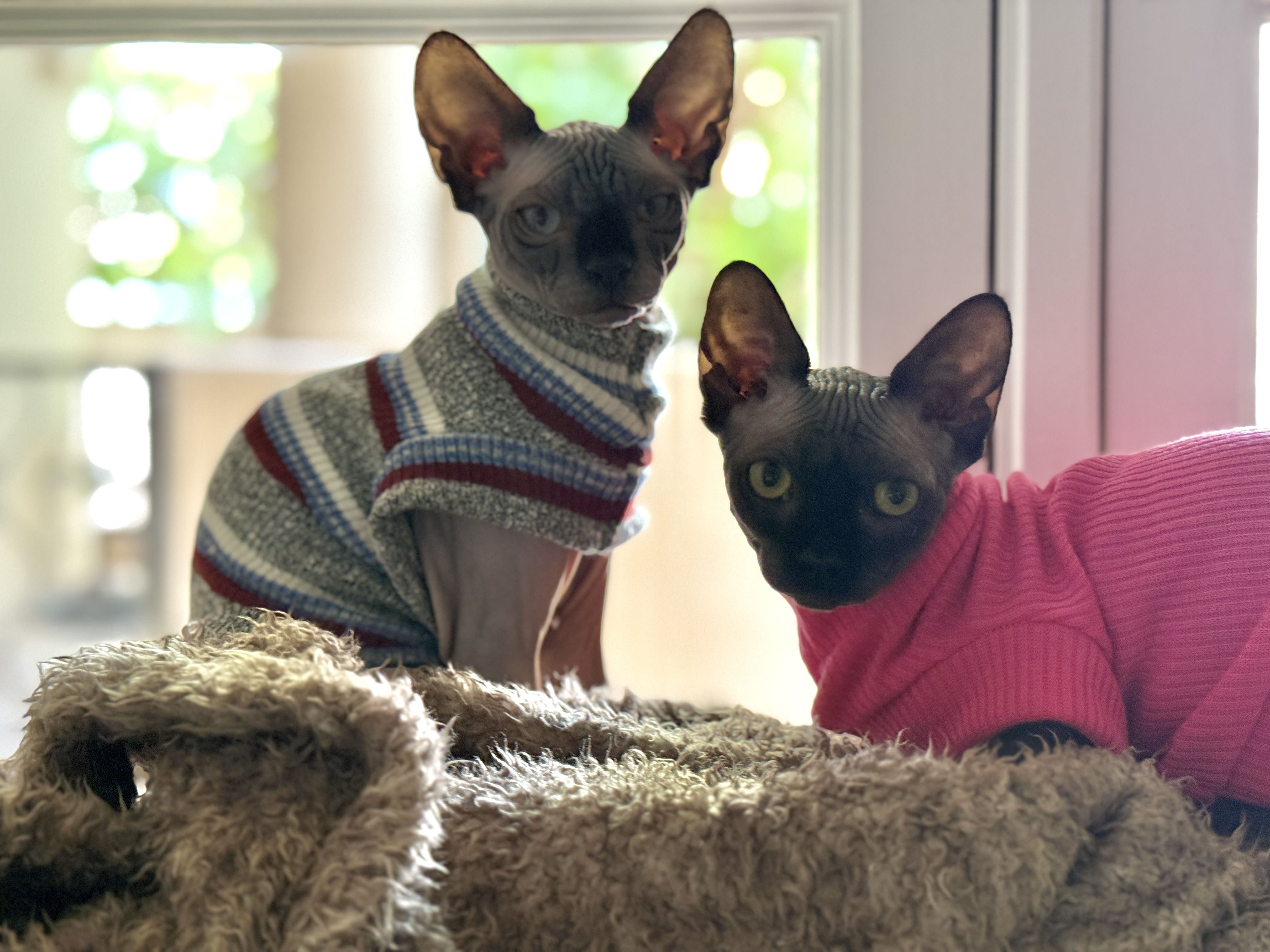
Lucy
In active care for atopic dermatitis. April 2026 IgE panel found environmental allergies — top triggers Lamb's Quarter, Scale, Melaleuca, Maple, Sycamore, Timothy. Intralymphatic immunotherapy (ILIT) started May 8, 2026. Earlier coughing turned out to be part of the same allergic disease — full cardiac workup was clear.
Gracie
Chronic ocular condition. PCR confirmed FHV-1 and Mycoplasma felis March 2025. Imperforate puncta both upper lids, blocked nasolacrimal ducts, symblepharon OS. Spayed May 2025 with concurrent tear-duct flush and microchip. Famciclovir as flares occur.
Recent activity
Upcoming care
Today's brief
Lucy.
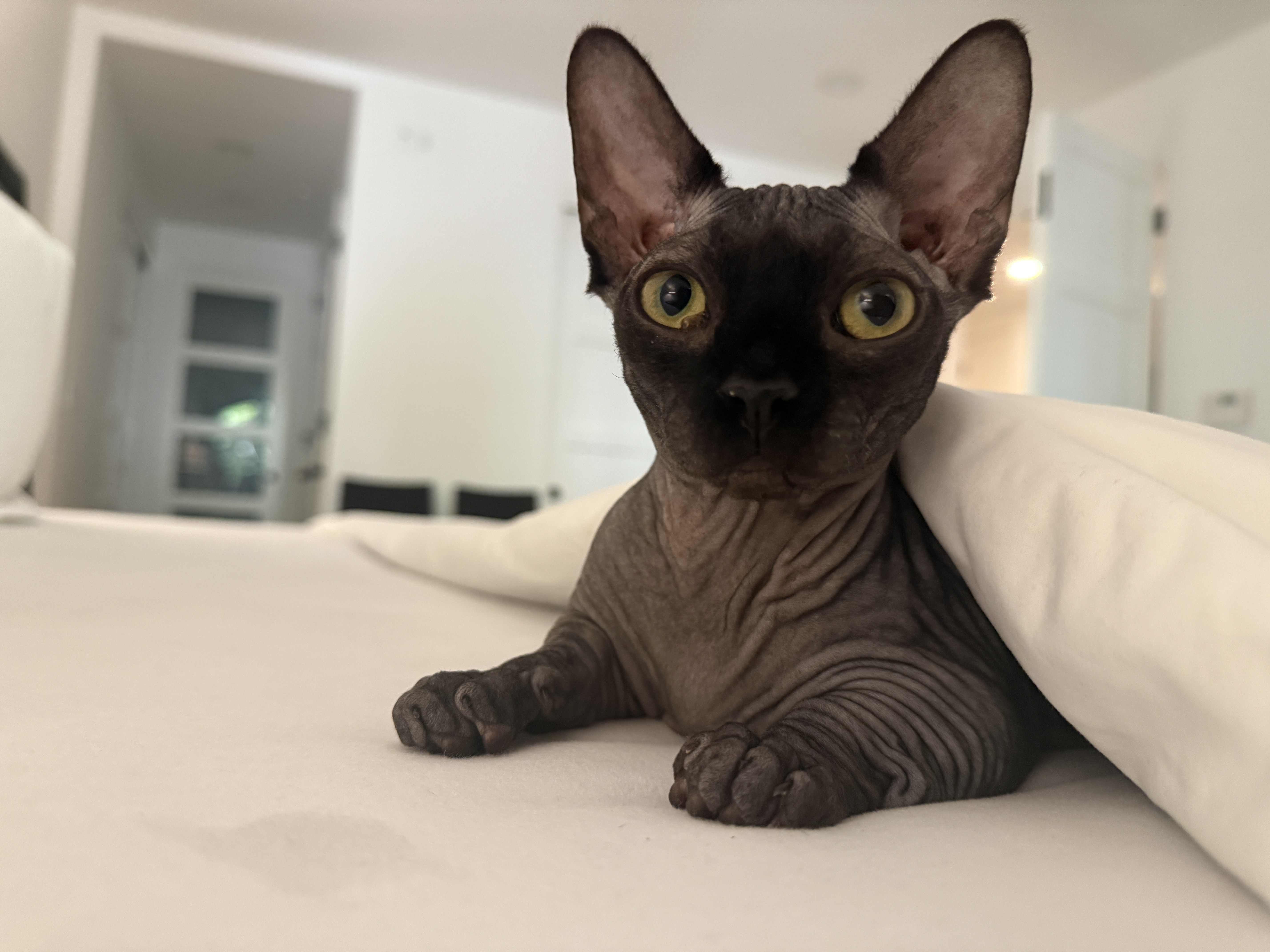
Adopted from Purrxotics on November 7, 2024 (~6 weeks old). Currently 19 months old. Black, hairless, spayed female. Microchipped (Fetch-ID). Active dermatology care.
Active diagnoses
Weight over time
Current medications
Diet
Food allergies were ruled out, but she has stayed on the hydrolyzed-protein dry food as her standing diet.
Dry food: Royal Canin Veterinary Diet Adult Hydrolyzed Protein HP — out all day, free-feed
Favorite Treat: Vital Essentials freeze-dried raw duck liver
Water: water fountain
Litter
Box: Litter-Robot 4
Insurance
Policy
(shared with Gracie)
Full visit history
Gracie.
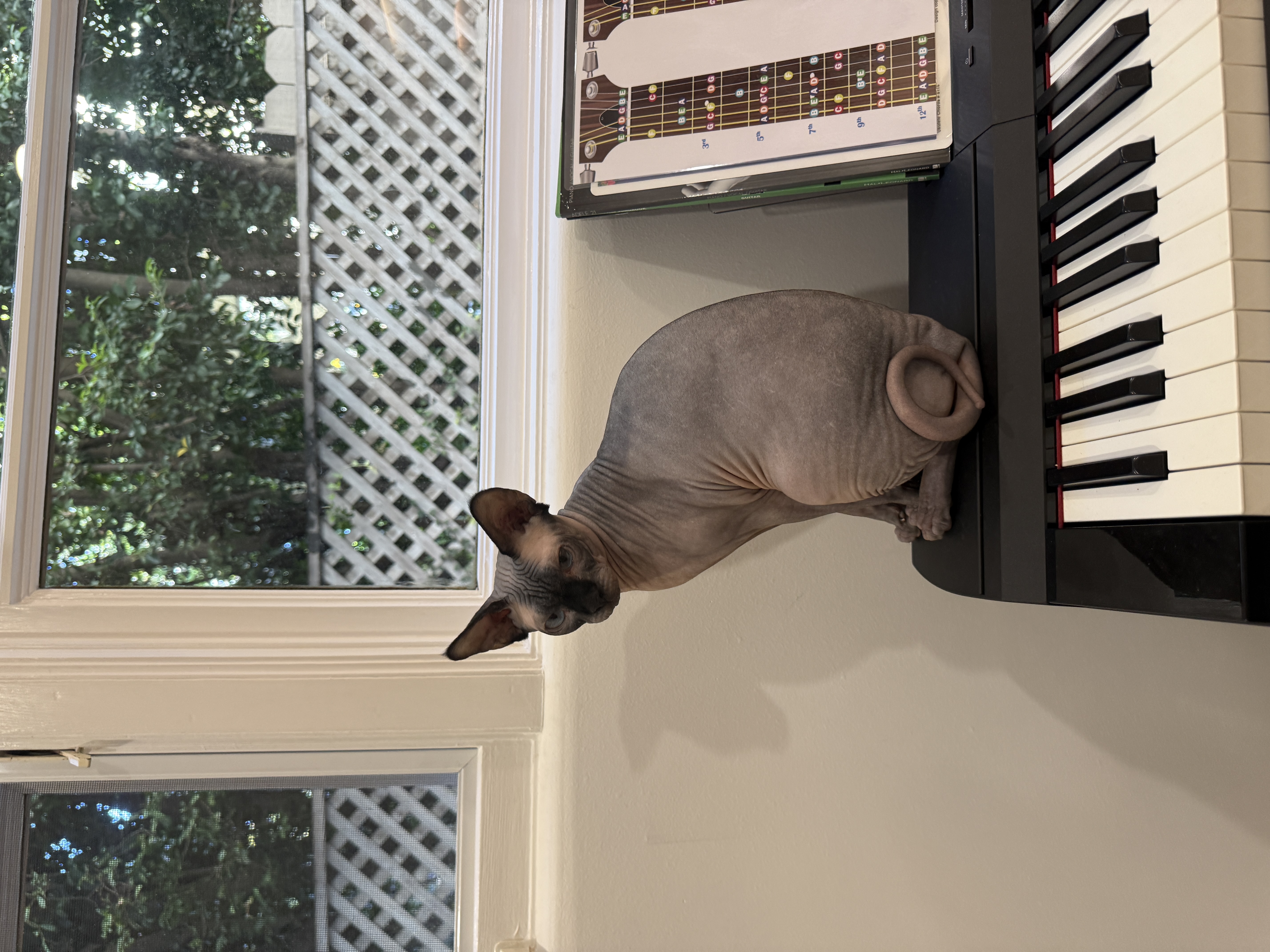
Adopted from Purrbastet on November 9, 2024. Currently 19 months old. Pink, hairless, spayed female. Microchipped (PetLink) on May 8, 2025 alongside her spay surgery. Active ophthalmology care.
Active diagnoses
Weight over time
Current medications
Diet
Dry food: Royal Canin Veterinary Diet Adult Hydrolyzed Protein HP — out all day, free-feed (shares Lucy's dry food)
Favorite Treat: Vital Essentials freeze-dried raw minnows — chicken-free, safe with her allergy
Water: water fountain
Litter
Box: Litter-Robot 4
Insurance
Policy
(shared with Lucy)
Full visit history
What they can't be around — and what to do instead.
A reference for both girls. Confirmed allergens, ingredient screening, household guidance, and prompts you can hand to Gemini for deeper interpretation.
Lucy Environmental allergies
Bambino · Atopic dermatitis · Allergic cough · No drug allergies on file. Confirmed via VARL IgE panel, April 2026. Atopic dermatitis driven primarily by plant pollens — trees, weeds, grasses — plus citrus, Malassezia, and feathers. Contact reactivity to OxiClean. Intralymphatic immunotherapy (ILIT) started May 8, 2026.
Avoidance guidance — products & ingredients
⛔ Avoid
Eucalyptus — VARL class 2. Diffusers, vapor rubs, "calming" sprays.
Citrus / Orange — VARL class 3. D-limonene is a common cleaner solvent; check ingredient lists.
All essential oils & plant-derived fragrances — overlap risk with her confirmed botanicals.
OxiClean (orange cap) — confirmed contact reactivity, likely the fragrance/surfactant additives.
Fragranced laundry detergent — regular Tide is out; stay on Tide Free & Gentle.
Feather toys / down bedding — VARL class 2 for feathers.
✓ Prefer
Plain water or fragrance-free, dye-free, essential-oil-free solutions in floor cleaners. Verify Dreame fluid ingredients before refilling.
Fragrance-free enzymatic cleaners like Rocco & Roxie unscented for spot cleaning.
HEPA air filtration in the rooms she sleeps in — pollen is the dominant environmental driver.
Close windows on high-pollen days, especially during peak tree, weed, and grass seasons.
Apoquel 3.6 mg twice daily + Animax topical for flare-ups.
VARL IgE Panel — Apr 16, 2026
General care for Lucy
Bathe carefully. Use only what Dr. Lancellotti has prescribed (Miconahex Triz when active). Avoid anything "natural," "herbal," "calming," or with citrus or tea tree in the ingredient list — even pet-marketed products.
Patch-test new products. One pillowcase or blanket, washed once, placed where she lounges. Watch for several days before scaling up to whole loads.
Track her doses. When the cough flares and the skin flares together, that's allergic disease — not cardiac. Her heart is healthy (full April 2025 workup was clean).
Immunotherapy is the long game. Allergen immunotherapy takes 6–12 months to show meaningful results — keep the schedule even on her good weeks.
Watch for OxiClean overlap. Any laundry product with perfume, dye, or aggressive surfactants is suspect until patch-tested.
Take Lucy's allergies to Gemini
Tip: when Gemini suggests a product, double-check the current label against this page — formulas change.
Gracie Drug allergy + food allergy + sensitivities
Sphynx · Chronic FHV-1 + Mycoplasma felis · Drug allergy + food allergy on file. Confirmed allergy to Terramycin ophthalmic ointment, and a food allergy to chicken. As a sphynx, her skin readily picks up airborne dust and particulates — environmental sensitivity is a constant, even when other cats wouldn't notice.
Environmental sensitivities
⛔ Avoid
Aggressive bathing — sphynx skin needs a careful routine; over-cleaning strips natural oils.
Terramycin for any future eye infection — confirmed drug allergy.
Chicken in food and treats — confirmed food allergy. Watch for chicken meal/fat in ingredient lists.
✓ Prefer
BioHAnce 0.4% gel drops 1–2× daily for eye lubrication, especially at bedtime.
Wipe-down routine per Dr. Rettinger's guidance — gentle, fragrance-free.
Tobramycin 0.3% on file for conjunctivitis flares — 3× daily × 7 days, then recheck.
Take Gracie's allergies to Gemini
Tip: bring the prompt into the conversation with her ophthalmologist if a new flare needs a different antibiotic.
Everything they're on, and everything they were on.
Tagged by cat, condition, and prescribing vet. Tap any photo placeholder to add a picture of the medication or label — stored locally in your browser.
Primary and specialist vets.
Active providers first; former providers we've moved away from below.
Active providers
Suggested next visits
Former providers
Records from these clinics remain in the visit history. We don't return for ongoing care.
Visit history
Every clinic visit and lab across both cats — filterable.
Emergency reference
For 24-hour clinics, primary vet, and insurance, see the Emergency tab.
If something is wrong right now.
Tap a phone number to call. Closest 24-hour clinic is M.A.S.H, 2.7 miles away. Always call ahead so they're ready.
Lucy Bambino
Gracie Sphynx
24-hour emergency clinics
Call before driving — they'll triage you. Distances are from West Hollywood.
Primary vet
(323) 654-7060 · lph@laurelpethospital.com
7970 Santa Monica Blvd., West Hollywood, CA 90046
Insurance — Trupanion
(855) 650-0666 — Trupanion claims
Direct-pay accepted at most ER vets — ask the clinic to call Trupanion before you pay.
When to go to ER vs. urgent care
- Go now: difficulty breathing, collapse, repeated vomiting, blood in urine/stool, suspected toxin ingestion, seizure, eye injury, allergic reaction (facial swelling).
- Same-day urgent: not eating >24h, lethargy, persistent diarrhea, limping, mild eye discharge, skin abscess.
- Routine flare (e.g. Lucy itch flare, Gracie eye discharge similar to past episodes): follow her existing PRN protocol unless symptoms escalate.
The reading material, in one place.
General guides from their vets — how-tos and reference sheets — plus imaging.
Patterns across them.
Side-by-side comparisons computed from the actual record. Useful for spotting things that might warrant a vet question.
Weight trajectory
Computed insights
Visit frequency by clinic
Quick takeaways
- Both girls were spayed within ~5 weeks of each other (Gracie May 8, 2025).
- Gracie's eye condition surfaced almost immediately at adoption (~7 weeks old per ophthalmologist).
- Lucy's skin issues escalated sharply in early 2026 — January scabbing → February rechecks → April formal allergen panel → intralymphatic immunotherapy (ILIT) started May 8, 2026. Five monthly injections in (through Aug 24), her skin is clearly better, though she remains on a standing twice-daily Apoquel.
- Both girls get their dental cleanings at K9Grillz together — first on February 11, 2026, second on July 16, 2026; both non-anesthetic with no anesthetic work required.
- The Melrose Vet appears most often in their visit count, but is not part of the active care plan going forward.